Internacional, Portada

Telescopio Hubble detecta la estrella más lejana jamás vista

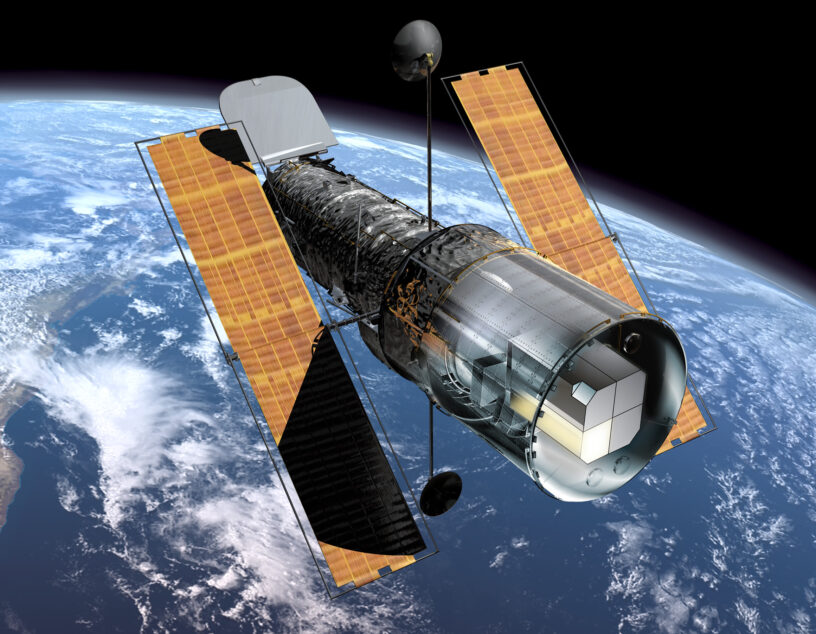
This illustration shows the NASA/ESA Hubble Space Telescope in orbit above the Earth as it looked before the Second Servicing Mission in 1997. The Faint Object Spectrograph (FOS) can be seen (marked in yellow) in Hubble's instrument bay at the back of the observatory. During the Second Servicing Mission the two first generation instruments, FOS and the Goddard High Resolution Spectrograph (GHRS), were replaced by the second generation instruments, NICMOS (Near Infrared Camera and Multi-Object Spectrometer) and STIS (Space Telescope Imaging Spectrograph). A dedicated team effort to understand and correct systematic effects in observations from FOS has now been concluded and the results are released on 11 September 2001. A four-person team based at the Space Telescope-European Coordinating Facility (ST-ECF) in Garching, Germany, has carried out this re-calibration with support from scientists at the Space Telescope Science Institute and the Goddard Space Flight Center. ST-ECF's 'Instrument Physical Modelling Group' has expended ten man-years of effort in understanding the intricate details of the instrument and in developing a novel physical model of its operation. This has allowed them to develop routines to correct for unwanted instrumental and environmental effects in the measurements of stars and galaxies.

diariodominicano.com

   LOS ÁNGELES, 30 mar (Xinhua) -- El Telescopio Espacial Hubble de la Administración Nacional de Aeronáutica y el Espacio (NASA, por sus siglas en inglés) detectó la luz de una estrella que existió en los primeros miles de millones de años posteriores a la gran explosión de origen del universo (big bang), la estrella individual más lejana jamás vista hasta ahora.
   El hallazgo estableció un  "nuevo y extraordinario hito" , señaló hoy la NASA.
   La estrella recién detectada está tan lejos que su luz tardó 12.900 millones de años en llegar a la Tierra, indicó la NASA.
    "Al principio casi ni lo creímos. Estaba mucho más lejos que la anterior estrella más distante con más alto desplazamiento al rojo" , dijo el astrónomo Brian Welch de la Universidad Johns Hopkins en Baltimore, autor principal del artículo sobre el descubrimiento publicado hoy en la revista Nature.
   La magnificada estrella fue llamada  "Earendel" , palabra que significa  "estrella de la mañana"  en inglés antiguo.
   El descubrimiento entraña la promesa de abrir una era desconocida de la muy temprana formación de estrellas, indicó la NASA.